Hospital on the Hill
The Box ManHospital on the Hill stands at the top of a slope and becomes the setting where the Box Man Narrator’s wound brings him into contact with a nurse and a doctor whose identities are more complicated than they first appear. It is at once a working medical space, a refuge from life inside the box, and a place of concealment: its rooms shelter treatment and professional routines, while its windows let the narrator watch from outside. The hospital’s ordinary architecture gives those encounters their force, making care, intimacy, and illicit practice converge in one building.
Setting and Approach
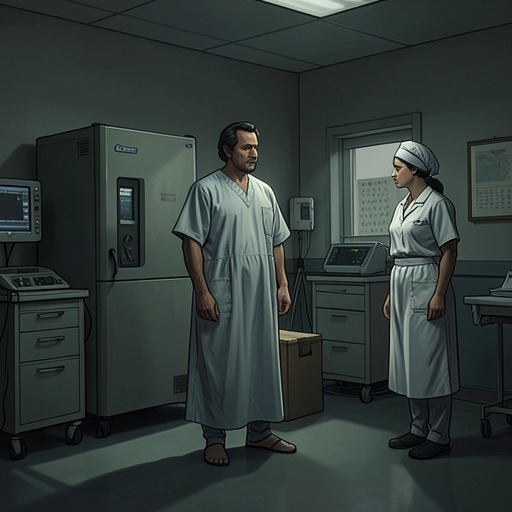
The hospital is reached by a sloping road. After a young woman on a bicycle tells the Box Man Narrator that a hospital stands at its summit and leaves money for him, he initially treats her charity as separate from his encounter with the air-rifle attacker. By dawn, however, his shoulder wound has begun to fester. The pain is described as constricting him, and he leaves the box to seek help at the hospital. The bicycle girl is there with a hypodermic needle; the air-rifle man holds a scalpel. Their presence turns the hospital into the point where two figures the narrator had kept mentally apart are revealed to belong to the same medical setting.
A later approach shows the hospital from its less public side. Rather than ring the special night bell at the closed iron entrance or face the doctor, the narrator steps over a hedge and enters the garden. A dog is already waiting there; he has won it over with food and it does not bark. Weeds surround the remains of an old flower bed, and the narrator stumbles over its edging stones. The darkened garden, closed portal, and unlit outdoor route set up a clandestine visit rather than an ordinary return for care.
Treatment and the Nurse
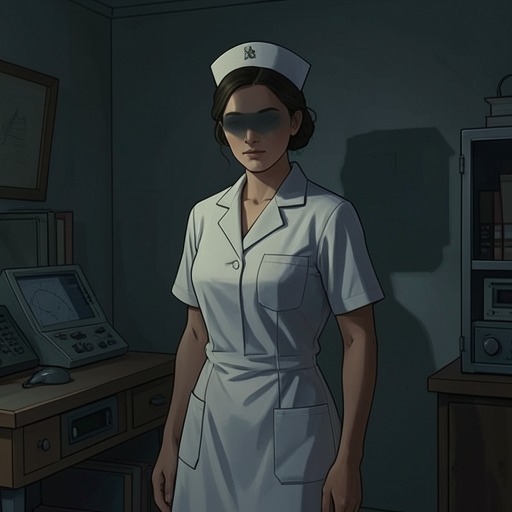
After the narrator reaches the hospital with his worsening wound, he wakes in a bed. The nurse watches him, and the room carries a heavy smell of disinfectant and vitamins. With the box removed, he experiences an unusual sense of release and forgets, for a time, that his face is exposed. As he tells her scattered details about himself, she smiles encouragingly. He reads that smile as an almost defenseless expression of affection, although the feeling is his interpretation rather than a promise she has made.
The encounter changes what he imagines doing next. Intoxicated by the nurse’s smile, the narrator feels that he may not need to return to the box. He promises to buy a box from the box man for fifty thousand yen and says he would sell it to her for nothing. He is too affected by her smile to ask what she intends to do with it. The hospital therefore becomes more than the place where his injury is treated: it is where his desire to leave the box begins to take the shape of a promise, even though he does not understand the promise himself.
Garden Windows and Hidden Sight
Less than an hour after the nurse has given him money, the narrator returns hoping to speak with her, return the fifty thousand yen, and ask her to cancel his promise to throw the box away. Her room is at the rear of the building, the second window from the left. He believes she may still be awake and imagines that he could talk with her even through the window; depending on her response, he might help her in another way. His stated purpose is a conversation, but a light in a different window draws his attention toward the hospital’s interior.
The illuminated window belongs to the waiting-room side of the building. Beyond it, the narrator understands, are the examination room and medical instruments. Its lower half is frosted, and its height prevents him from looking in directly. He uses a rearview mirror he has kept in his tote bag, raising it at an angle beneath the narrow window until he can see inside. The device turns the building’s barrier into an instrument of observation: rather than enter the room, he constructs a reflected view from the garden.
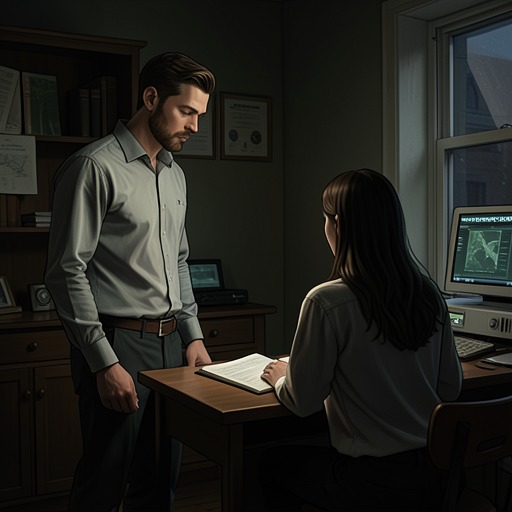
The reflected room is the doctor’s sitting room and study. It contains an electric table lamp on a large work desk, a white hospital bed, and a bookcase crowded with old magazines and books. Its walls and door are old, their scratches showing through layers of paint; a stereo set stands beside the desk. The narrator later recalls this furniture as less important than the people in the room. He sees Toyama Yoko standing naked and talking to someone. The sight overturns his assumption that the lit room was merely an accidentally illuminated part of the clinic, and the hospital’s window becomes the frame for a private scene he was not meant to see.
Medical Practice and Institutional Compromise
The hospital’s doctor is not simply the licensed medical figure the setting might suggest. In an affidavit, C explains that the body at issue is that of the Army Medical Captain whose name and identity C borrowed in order to practice medicine. C had served as the captain’s medical orderly during the war and, under his guidance, performed complicated operations while the captain pursued research into producing sugar from wood. After demobilization, the two opened a clinic together; the captain’s illness left him unable to examine or treat patients, while C continued the practical work.
C’s account presents the clinic’s operation as a tangle of care, dependence, and unlawful impersonation. C says that he administered drugs to the captain, whose addiction had developed during the war, and continued because he lacked the courage to abandon him. The captain’s wife, Nana, managed the accounts; she later lived with C, with the captain’s understanding. C also says that patients trusted the practice and that his surgical skill and growing medical knowledge helped sustain his confidence, but he acknowledges that experience and reputation did not make unauthorized practice lawful.
In the eighth year of the practice, the captain’s speech and conduct drew abuse and suggestions that he was mad, while scrutiny of the clinic’s excessive drug use made the arrangement feel increasingly dangerous. The clinic closed and moved to the city. As the captain’s suicidal inclination grew more pronounced, Nana suggested that C register as the captain and appear publicly under his identity; C says the captain agreed. In the affidavit, C ultimately states that being a fake doctor constituted a crime and that he wanted to disclose the truth. This account lends the hospital setting a second meaning: behind its visible routines of treatment lies a medical authority sustained by skill and patient confidence, but also by borrowed identity, drug dependence, and acknowledged illegality.